How to Clean a Stainless Steel Railing Without Damaging It
Stainless steel is called stainless, not stainless-proof. It resists corrosion because a thin oxide layer keeps reforming on the surface, and almost every problem people have with a stainless railing comes from something that stops that layer doing its job.
Which is why the most common mistake is cleaning it too hard rather than too little.
The brown speckling is not rust from the steel
Fine orange-brown spots on a stainless railing, usually near the coast, are tea-staining. It is surface discolouration caused by chloride in the air attacking the passive layer. The steel underneath is normally sound.
It is far more common on 304-grade stainless than on 316. The difference is molybdenum, which is what gives 316 its chloride resistance, and it is the reason 316 is the grade that belongs anywhere near the sea. If a railing in Mumbai, Chennai or Kochi is speckling within a year or two, the grade is usually the explanation, not the cleaning.
Caught early it wipes off. Left for a couple of seasons it etches in and needs mechanical work.
Routine cleaning, which is nearly all of it
- Wipe with a soft cloth and warm water. For most indoor railings this is the entire maintenance routine.
- If there are marks, add a little mild detergent or dish soap. Nothing abrasive.
- Rinse the detergent off. Residue left on the surface attracts dust and holds moisture.
- Dry it. This is the step people skip and it matters more than the washing. Water left to evaporate leaves mineral spots, and in hard-water areas those spots are what people mistake for damage.
- Wipe along the grain, not across it. Brushed stainless has a direction, and cross-wiping shows as a haze under raking light.
Twice a year, run a hand along the whole rail and check the bracket fixings while you are there. That is the actual inspection.
What not to use, and why
- Steel wool or a wire brush. The worst thing you can do. It leaves carbon-steel fragments embedded in the surface, and those particles rust and bleed into the stainless. The railing then appears to be rusting when it is the contamination rusting.
- Chlorine bleach or anything with hydrochloric acid. Chloride is the one chemical family stainless genuinely dislikes. Many bathroom and tile cleaners contain it.
- Abrasive cream cleaners and scouring pads. They scratch the passive layer and leave a permanently duller patch.
- Hard water left to dry. Not a cleaner, but the most frequent cause of a railing that looks neglected.
- Silver or brass polish. Formulated for other metals and often mildly abrasive.
Removing marks that will not wipe off
Fingerprints and smears
A microfibre cloth with a little warm water and detergent, then dried. Proprietary stainless cleaners work but are rarely necessary, and the oily ones need buffing off or they attract more dust than they prevented.
Light tea-staining
A non-abrasive stainless cleaner or a nylon pad rated safe for stainless, worked along the grain, then rinsed and dried thoroughly. Test on a low spot first. Once the discolouration is gone, the surface needs to stay dry more often, or it returns.
Embedded contamination
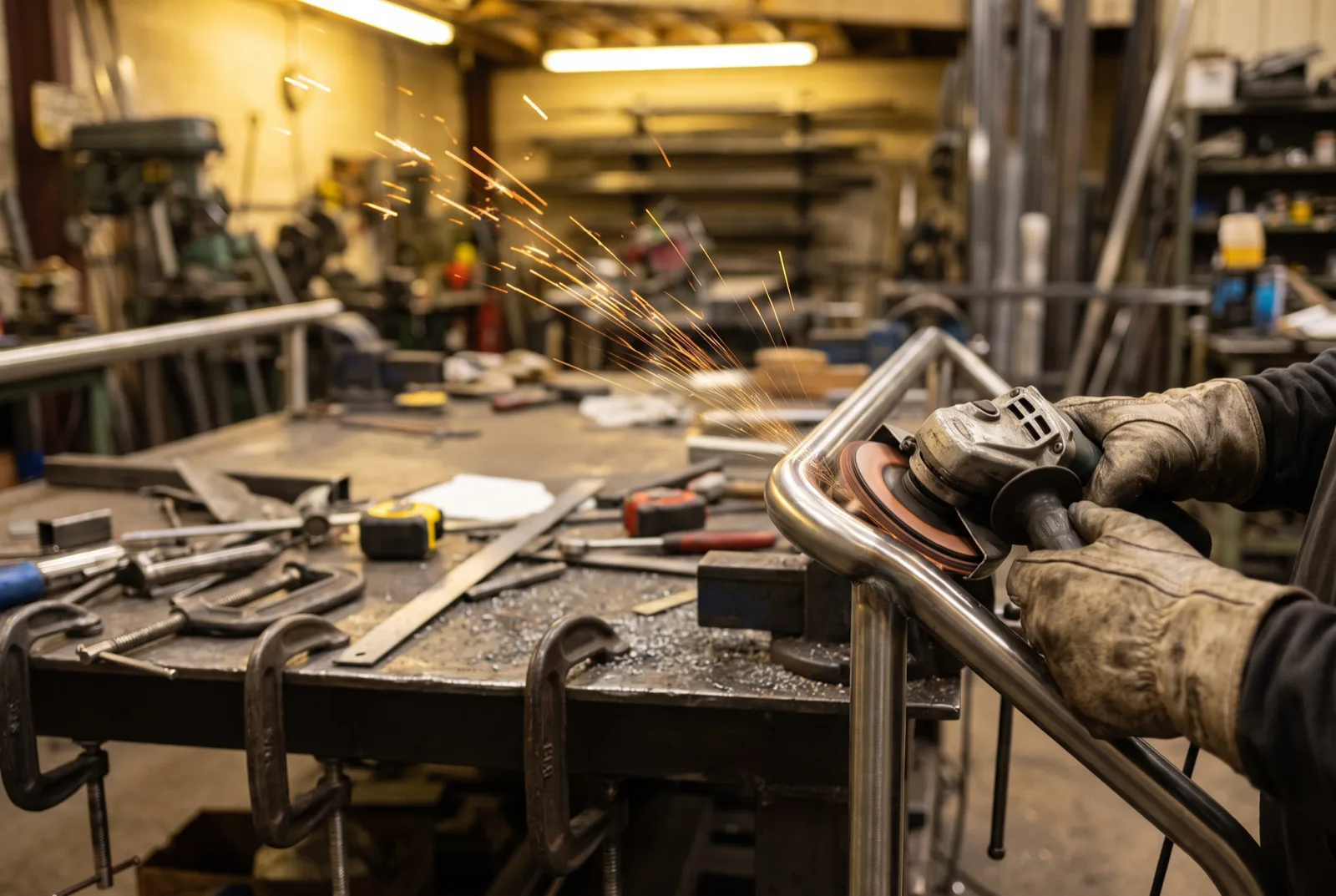
If steel wool has been used, or grinding was done nearby during construction, the fix is passivation or repolishing rather than cleaning. That is a workshop job, not a household one.
Prevention beats all of it
- Specify 316 near the coast. Choosing 304 to save money in a chloride environment is the decision that causes most of these problems, and it cannot be cleaned away afterwards.
- Keep mop buckets away from the base of posts. Standing water at a fixing is where trouble starts on any metal.
- Rinse coastal and terrace railings with fresh water occasionally. Salt does not wash itself off.
- Do not let plaster, tile grout or cement splashes dry on stainless during renovation. They are alkaline and they etch.
For care across all the other materials on a staircase, including timber treads and glass balustrades, see our staircase maintenance guide. If you are still choosing, staircase materials for Indian conditions covers where each grade belongs, and railings and balustrades covers the systems we build.
If a railing is pitted rather than stained, or the marks return within days of every clean, send a photograph. Pitting is a different problem from discolouration and it does not clean out.
For the stainless railing systems we fabricate and install, in grade 304 and 316, see SS railings.